As our class continues to explore the idea of appropriation in art, or rather appropriation art, we have turned our attention to the incredibly influential artist John Baldessari. In an extended interview Baldessari gave he discussed the genesis of his style, saying that after years of documentary-style photography, he came to an epiphany. He stated that he didn't see much of a point to creating new images/photographs, given that there were already so many of them out in the world. He turned to the use of things such as movie and television stills, as well as other's photographs that he would sometimes fish out of garbage bins at photo processing plants.
Above is a work entitled Rollercoaster (1989-90) by John Baldessari, and once again to copyright infringement is intended. Part of a series of prints (an edition of 45), this work captures my attention and my imagination. In some of Baldessari's more recent works (such as his overlap series) I believe that he has taken some photographs himself. However, it is certainly possible and would even be typical if the image of the roller coaster above was not an image originally taken by Baldessari.
I love the way Baldessari's adaptations and additions to the image of the roller coaster only seem to add to the piece's sense of form. Rather than covering it up, and making the image more chaotic, the large black block and the curving lines of color work to reveal that shape of the familiar amusement park ride. Indeed, it becomes something other than the ride we all know, with the interlacing lines of the coaster almost twisting themselves into the double helix of a DNA strand. I do not know whether this was Baldessari's intent or not, but it is a shape I cannot quite ignore. I am also very fond of the sense of movement that the piece has, even though the coaster is frozen in a snapshot of time. Mixing black and white with such a bold red, and then a relatively cool-feeling green makes the piece truly stunning, and lends it visual power.
I have spoken about what I think of the piece, but I am not sure whether I am supposed to further address the idea of appropriation in the piece above. As I mentioned, it is difficult to be sure whether the roller coaster image was taken by Baldessari or someone else. No matter which of these is the case, it is certainly true that Baldessari selected the image for his work, and I think that selection plays a very important role in art. It does in anything, really. What you choose to write about, drawing, paint, photograph, etc... It important to select what you need to impart the specific message you're trying to send out into the world. By virtue of Baldessari's selection and adaptation of the roller coaster image, surely we can say that Baldessari created a piece that is uniquely his own - a product of his particular artistic vision.
-Kelly F.
Wednesday, August 31, 2011
Friday, August 26, 2011
First Post - Somewhat Lacking in Originality?
Given the task of writing, using and/or updating a blog for my Beginning Digital Imaging class, I find myself facing my first post and not knowing quite what to say. Since this is supposed to be a creative endeavor, I don't really want to start out with some cliche first-post message or welcome... Then again, perhaps that's what I'm doing now.
Fortunately enough for me, our first assignment addresses the concept of using images and objects created by others - in this post, we were told to reflect on the nature of appropriation in art.
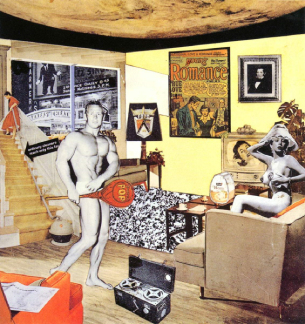
Above is a reproduction (taken from a public site) of the artist Richard Hamilton's early pop art work Just What Is It That Makes Today's Homes So Different, So Appealing? (1956). No copyright violations or infringement is intended.
I say this because I must admit, to my own shame and horror, that I am really unfamiliar with the laws that govern the use and/or reproduction of other people's works. So, I usually err on the side of paranoia. After all, how would I feel if someone were in some way abusing or misusing my artistic creations or words? However, the use of the image above is for purely academic purposes, and indeed I was asked to post just such an image under the terms of my assignment.
Hamilton's own re-use of images created by others (mostly pulled from popular advertisements of his time) did not have an academic purpose - not really... Instead, with the birth of pop art you saw people reusing the images that were constantly bombarding the public in a new way. The goal was to send a message - a powerful one - to throw light on those consumer images by and to which the public was (and today still is) growing desensitized. Sure, Hamilton was primarily using graphics created by others, but can you really say that Hamilton was stepping on the intellectual and creative toes of the original artists and designers?
The whole point of appropriation in art is to take that which was made by others, and in a sense to make it your own (or, at any rate, something it was not before). The appropriation in Hamilton's Just What Is It That Makes Today's Homes So Different, So Appealing? is the very thing which gives the work its power for social commentary. Appropriation can and must certainly raise questions about the point at which someone else's work becomes so altered that it belongs to someone else, or everyone else, I suppose.
All things to ponder. At any rate, I doubt very much that Hamilton would mind my using his piece for this exercise. And so, with little else original to say, until next time Internet...
-Kelly F.
Fortunately enough for me, our first assignment addresses the concept of using images and objects created by others - in this post, we were told to reflect on the nature of appropriation in art.
Above is a reproduction (taken from a public site) of the artist Richard Hamilton's early pop art work Just What Is It That Makes Today's Homes So Different, So Appealing? (1956). No copyright violations or infringement is intended.
I say this because I must admit, to my own shame and horror, that I am really unfamiliar with the laws that govern the use and/or reproduction of other people's works. So, I usually err on the side of paranoia. After all, how would I feel if someone were in some way abusing or misusing my artistic creations or words? However, the use of the image above is for purely academic purposes, and indeed I was asked to post just such an image under the terms of my assignment.
Hamilton's own re-use of images created by others (mostly pulled from popular advertisements of his time) did not have an academic purpose - not really... Instead, with the birth of pop art you saw people reusing the images that were constantly bombarding the public in a new way. The goal was to send a message - a powerful one - to throw light on those consumer images by and to which the public was (and today still is) growing desensitized. Sure, Hamilton was primarily using graphics created by others, but can you really say that Hamilton was stepping on the intellectual and creative toes of the original artists and designers?
The whole point of appropriation in art is to take that which was made by others, and in a sense to make it your own (or, at any rate, something it was not before). The appropriation in Hamilton's Just What Is It That Makes Today's Homes So Different, So Appealing? is the very thing which gives the work its power for social commentary. Appropriation can and must certainly raise questions about the point at which someone else's work becomes so altered that it belongs to someone else, or everyone else, I suppose.
All things to ponder. At any rate, I doubt very much that Hamilton would mind my using his piece for this exercise. And so, with little else original to say, until next time Internet...
-Kelly F.
Subscribe to:
Posts (Atom)